Views: 115 Author: ICEVER Publish Time: 2025-08-20 Origin: ICEVER

Providing your plants with proper lighting is one of the most important yet challenging factors, especially if your indoor garden has exotic plants.
We offer numerous different grow lights to gardeners whose natural lighting conditions can't meet the needs of their plants.
Read below to learn do LED grow light works and the pros and cons of every type of light and how to combine them effectively.
Plants need photosynthesis to provide nutrients. Photosynthesis depends on pigments, and the usable spectrum is limited. These pigments mainly absorb visible light between 400–700nm. The spectrum of “full-spectrum LED lights” mainly covers 380–780nm, which already meets the needs of photosynthesis. Therefore, they can fully replace sunlight. Experiments have confirmed their stability and better performance in cultivation.
|
|
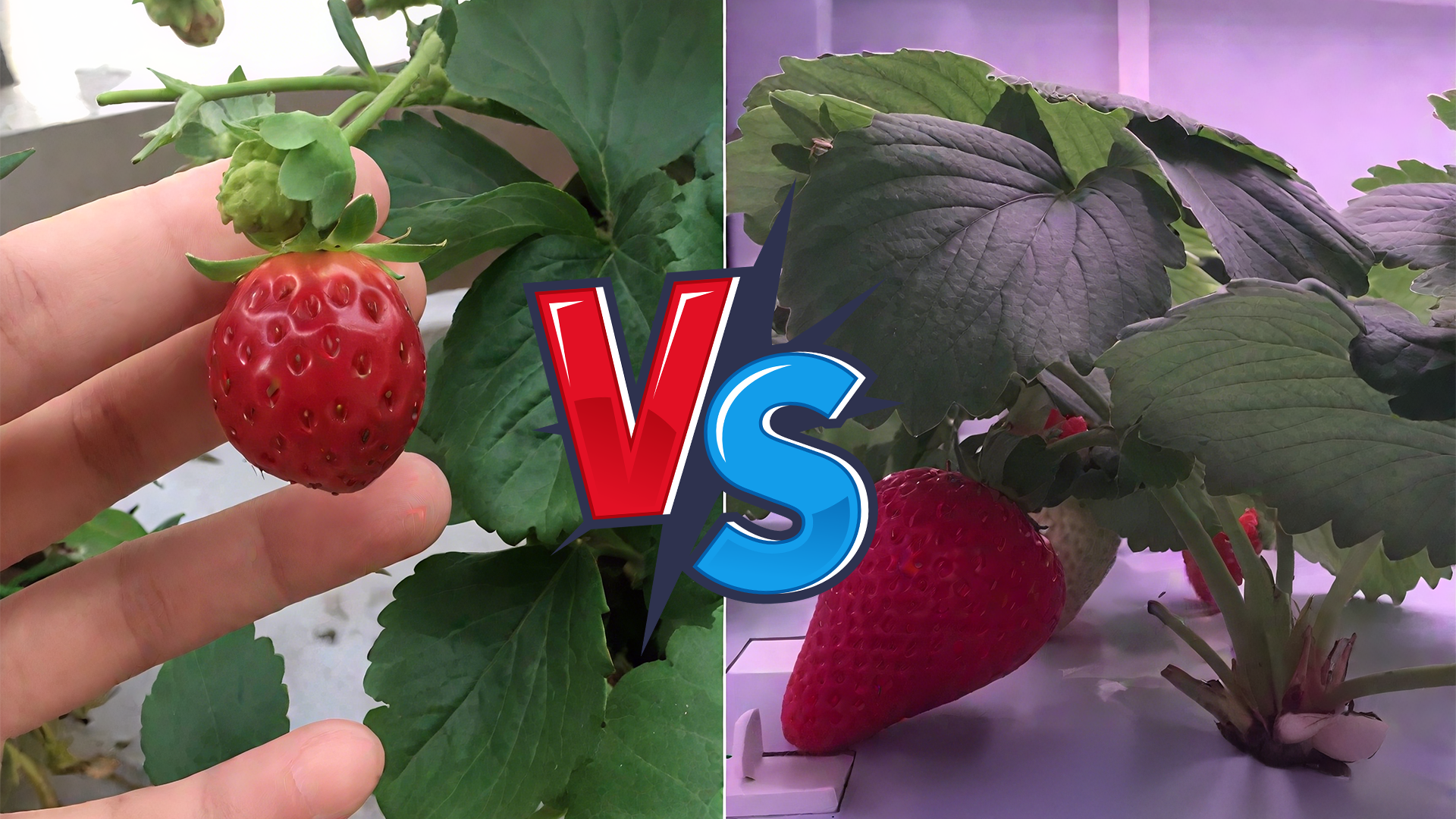
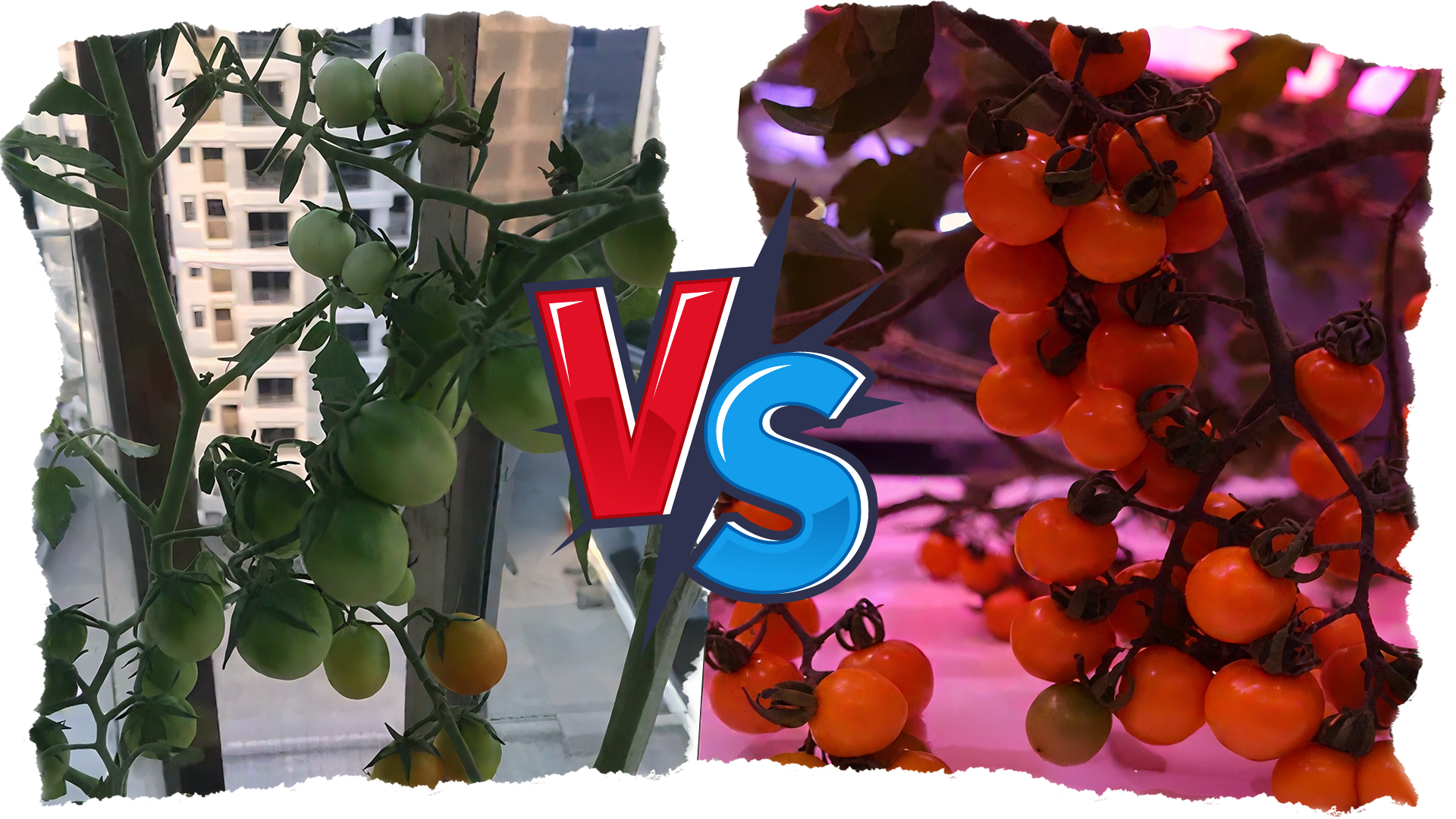
The instability of sunlight leads to instability in fruit size and shape. | Places with sunlight but insufficient intensity may cause plants to lack specific wavelengths of light, affecting yield. |
Different light sources have different spectra. By analyzing them and combining with plant science theories, we can tell how artificial light differs from natural sunlight.
Below are some general spectra of common artificial light sources for reference.
First, you need to understand the role of different spectrum ranges.
Ultraviolet light (300–450nm):
UV is the key region for plant phototropism. It affects plant morphology, promotes root development, and stimulates anthocyanin production. However, it may suppress stems and leaves. Its main use is in early stages to improve survival rate and suppress bacteria. Simply put, UV provides plants with a better early living environment. For plants with unique appearance traits, proper UV can change or enhance features. Of course, this depends on the plant species. Some confidential vegetable-growing studies confirm this conclusion.
--------------------
Blue light (450–495nm):
Chlorophyll a and b respond strongly to blue light. It promotes photosynthesis, root growth, and the synthesis of proteins and amino acids. This ultimately increases THC and CBD content in cannabis plants. This idea has been recognized since the start of plant–artificial light research. In fact, most daily lights already emit lots of blue light, since white LEDs are excited by blue chips.
--------------------
Green light (515–520nm) / Yellow-green (550–570nm):
Green light supports photosynthesis, especially when combined with other wavelengths. It can penetrate the canopy, boosting overall photosynthesis.
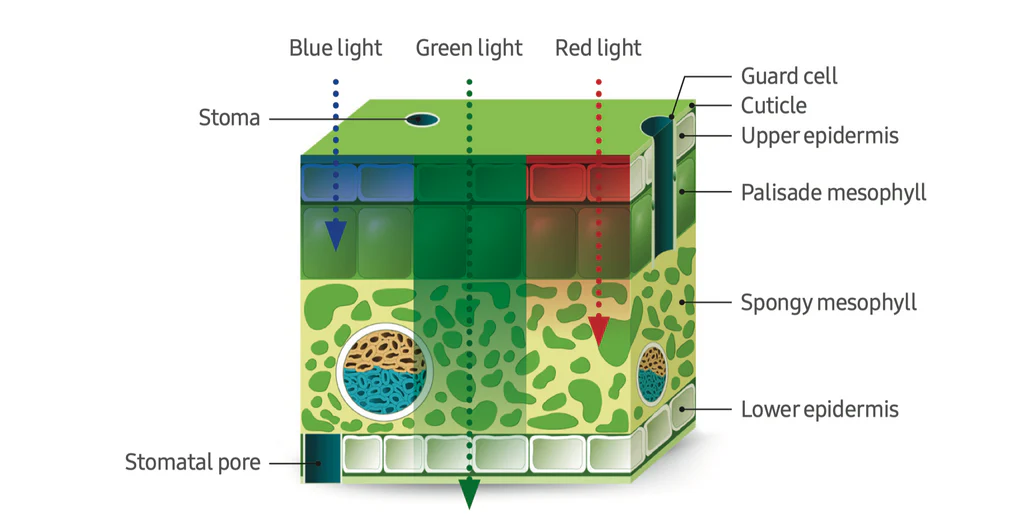
Blue and red light have long been mainly employed in horticulture lighting since it is well known that plants absorb them more efficiently. Other wavelengths, including green, have, however, attracted little interest.
From Samsung's vantage point, different wavelengths are really crucial for the general development of plants. Many both internal and outside experimental research have confirmed this. Although chlorophyll absorbs red and blue light mostly, green light absorption is less; about 80% of green light passes through the chloroplast (Terashima, 2009).
This lets green light find deeper chloroplasts within the leaf (Sun, 1998). The "backscattering effect" (Vogelmann, 2008) produced by the dispersion of green light inside the leaf expands the pathway of green light photons inside the leaf, thereby expanding the possibilities of chloroplast absorption and hence improving photosynthesis.
This perspective is consistent with the conventional wisdom that says plants mostly absorb red and blue light; nonetheless, past research sometimes neglected green light because of its reflection by chloroplasts.
Combining blue, green, yellow, and certain red wavelengths ( 660 nm and 730 nm), a full-spectrum white LED can offer ideal lighting for improved plant growth.
-------------------
Red light (620–750nm):
Red light promotes flowering and reproductive growth, increasing cannabis flower yield. These flowers usually contain the highest THC and CBD. Red light is most important in flowering and ripening stages.
------------------
Far-red light (~730nm):
Far-red regulates photoperiod by converting phytochrome PFR into Pr, affecting flowering time and quality, and ultimately increasing active compounds. Though less efficient than red/blue, it still plays a role. Imagine a young seedling shaded by a big tree. It stretches upward and outward toward unblocked light. This is the effect of far-red.
Plants do not have vision. What we describe as “sight” is actually their light-sensitive cells sensing light changes. When most light is blocked, far-red remains. That’s why far-red matters. When combined with red, it shows powerful effects.
------------------
This is the meaning of the spectrum.
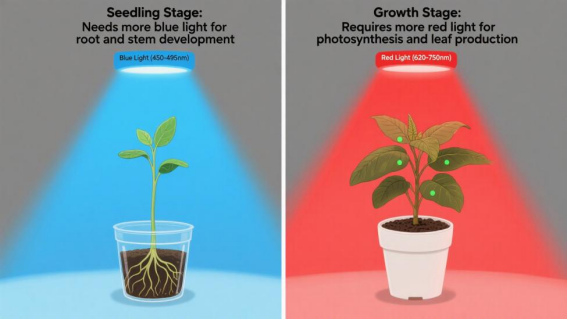
Then, you need to understand your plants’ needs. Red and blue colors of the light spectrum aren’t only responsible for proper growth, blooming, and fruiting but are also the most suitable for photosynthesis—the main process in a plant’s life.
At the same time, excessive red light leads to leggy growth and pale foliage, while too much blue light stunts growth and makes leaves small and dark. The green color is almost entirely reflected and used less. Keeping this in mind, let’s move on to the differences between natural and artificial lighting.
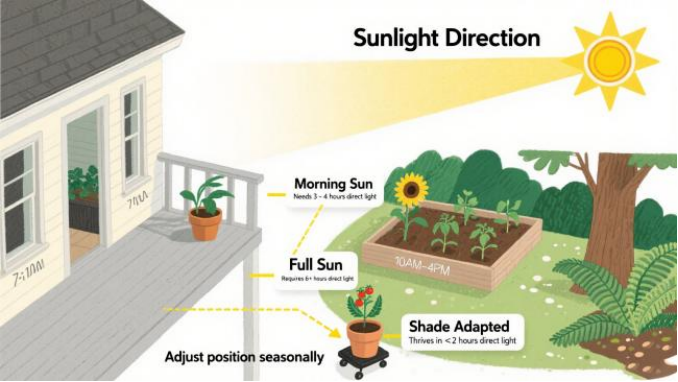
Supporting all the Earth life, sunlight has been letting plants grow, develop, and photosynthesize from time immemorial. It’s the most obvious lighting option both for indoor and outdoor species.
Free and unlimited. Natural lighting costs nothing and even produces energy itself, being the only eco-friendly option.
Stable. Since it’s a quite unchangeable source of energy, in most cases, all you need is to find an optimal place for your plant once and then rotate it from time to time and enjoy it thriving. Of course, seasonal and weather changes occur too, but they are usually beneficial since plants need different light intensity throughout the year.
Has the perfect wavelength. The sunlight spectrum can provide flora with the light of all the necessary colors. Both blooming and foliage plants would grow properly under it. However, it’s only partially true for houseplants, since glass can block part of the UV spectrum.
Isn't the same in different regions. Modern gardening isn’t limited to cultivating regional species, so quite often plants are grown in climates that they aren’t typical for. For example, it’s barely possible to make cacti thrive in cold regions with few sunny days and a small amount of daylight.
May create dangerous conditions. Warmth- and light-loving plants are often located right next to south-facing windows, which seems to be the obvious choice. However, glass overheats extremely in summer, causing the leaves that touch it to get scorched. You can solve this problem, though, by shielding your plant with a curtain. At the same time, plants placed on a windowsill to make the most of the winter sunlight can suffer from cold drafts.
Can't get to every corner of your house. Houses, as well as gardens, are limited in suitable places for plants. If you don’t have south-facing windows, your light-loving plant won’t grow well even if it’s warm and sunny outside.
So, despite being the key to healthy growth, sunlight isn’t always available in proper quality and quantity. In this case, grow lights are here to help.
Becoming more popular each day, grow lights are used nowadays not only to supplement insufficient natural lighting but also to replace it. As good as sunlight is, its excess is equally harmful to shade-loving plants as having a tropical species on a north-facing windowsill.

Always at hand. Whether you are growing a tropical plant or just want to make the most of the blooming period, grow lights will help when the season can’t boast plentifulsunlight.
Perfect for seedlings. While only some recently sown seeds need bright lighting, seedlings are extremely greedy for it. Therefore, using artificial lighting significantly increases the chance of growing a healthy plant. By placing seedlings no more than 6 in (15 cm) beneath a light source, you will ensure they are growing strong and evenly.
Lets you control the amount and quality of daylight. Combining different types of lights and adjusting the time they are on, you can create perfect lighting conditions for your plants, seemingly possible only in the wild.
Suitable for photosynthesis. Even usual white lights allow plants to photosynthesize.
Can provide a limited spectrum. Grow lights often produce either red, blue, yellow, orgreen colors. So you need to mix different bulbs and adjust their intensity to create theoptimal conditions for your plant’s healthy growth. However, white lights provide a full spectrum.
Expensive. Even the cheapest and questionably safe bulbs consume a lot of energy.
Environmentally unfriendly. Apart from consuming energy, most grow lights include non-recyclable materials.
We hate saying this, but the answer is not straightforward. If you're looking for the most natural and eco-friendly option and have access to abundant sunlight, then natural light is better. However, if you require more control over your growing conditions or are limited by geographic or seasonal constraints, artificial lights offer benefits that sunlight can't match.
In a perfect world, a combination of both light sources would be ideal for maximizing plant health and yield. Some commercial operations use natural light supplemented with artificial grow lights to achieve the best of both worlds.
An interesting fact: an experiment held at Purdue University has proved that LED lights can potentially replace natural lighting. The researchers managed to grow the leaf lettuce with the help of red and blue LED bulbs at a ratio of 95 to 5. They also hope to figure out how to increase and decrease lighting to adjust it to the growth stages of different plants. Of course, it’s still optimal to use sunlight if possible, but this experiment shows that people can grow plants in space.
First of all, don’t believe grow lights sellers assuring you that nowadays you don’t need sunlight at all. The rule of thumb is to provide your plant with the biggest amount of sunlight your house or garden can offer. Even if you have only north-facing windows, find the most well-lit spots in your house and improve the available conditions with the help of grow lights.
The best example of such a combination is growing plants in greenhouses. Experienced gardeners can make the most of sunlight and supplement it with artificial lighting, enjoying great harvests as a result. This method is more eco-friendly than creating entirely artificial conditions and doesn’t let them fail because of unstable weather.
The key to your plants’ well-being is mimicking their natural growing conditions. We recommend that you make the most of the available sunlight and take your time developing the optimal lighting schedule for your garden, both indoor and outdoor. Make sure to learn the lighting needs of your plants and the technical performance of different types of grow lights. Good luck on your journey to a healthy garden!
The above is the answer to the question. We are engaged in the manufacture of growth lamps. We have designed many different lamps according to different usage scenarios, and designed intelligent control, recycling, spectrum adjustment, and other functions according to user needs. You are very welcome to check out our website. The following is the product promotion
If you're considering the leap into artificial lighting for your plant cultivation—whether it's a small indoor garden orlarge-scale commercial operation—allow us to introduce you toV3 pro LED grow lights, one of the market leaders inhigh-quality LED grow lighting.

Here are some brief introduction about the advantage of this light.
First and foremost, different from traditional light panels,we divided the light source into many light bars. Compared with traditional plant lights that use light panels, this improvement makes the light distribution more uniform which increase the coverage and ensure the light reaches the plant surface uniformly.
These bars can maximize the contact between heatsink and the air avoiding heat accumulation from concentrated light which makes the V3 pro series has superior heat dissipation. Its design conforms to the concept of environmental protection and it is indeed an environmentally friendly product.
And at the same power level,V3 pro series light may provided more light energy which can help to reduce the energy consumption and effect of the environmental benefit from the higher PPE and PPF.
Secondly,We have made a new design in appearance. we increase 180 ° foldable design in V3 pro light.The folding corners are made of silver, which is the same color as the lamp body, and the overall appearance is very beautiful.
It makes V3 pro light differ from the traditional light which can not only reducing the products's transportation length and decrease the possibility of damage during transit but also can make the installation much easier for our clients.
Thirdly, We have made improvements on the spectrum. the V3 pro spectrum can be adjusted and customized which can provide precise lighting support for your plants.
In the past practical, our clients have used it in cannabis cultivation and the effect is remarkable. The V3 grow light helps improve the synthesis of key active compounds such as THC, CBD, and terpenes in cannabis, thus enhancing the overall quality of the crop.
What's more, we have been updating and improving product functions based on customer needs. In the development of this V3 product,we’ve reserved interfaces allowing you to customize your grow tent or grow light system as your own growing habits.
We can provide you with a more professional response based on your ideas and develop a planting plan that is more suitable for you.Whether it's for custom grow lights or specific tailored solutions,we would welcome the opportunity to discuss how a collaborative partnership can support your business objectives.